Expense management tools no longer just capture receipts. They help modern teams control spending, enforce policies, and turn raw expense data into insights — all while making life easier for employees and finance teams alike. To understand how these tools differ, it’s useful to look at the approach each one brings to the table.
Here’s a closer look at five leading expense management platforms and what kind of work styles they best support.
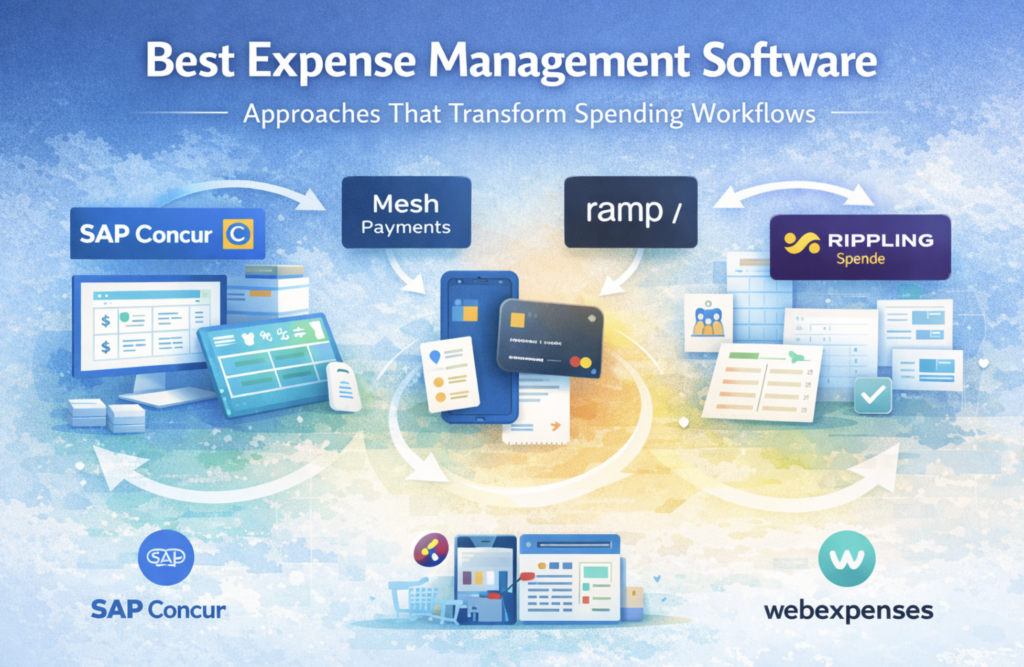
SAP Concur — Expense Management as a Comprehensive Financial Backbone
SAP Concur has long been a go-to solution for companies that treat expense workflows as part of broader finance operations. It’s not just a way to submit receipts — it’s a tightly integrated system that connects travel, invoices, and expense data into one place.
This approach suits organizations that:
- work across locations or geographies
- need consistent, policy-driven expense controls
- want deep workflows that span beyond simple reporting
Finance teams often value Concur for its integrated compliance and approval workflows, especially when expense reporting is only one piece of a larger financial ecosystem.
Mesh Payments — Modern Spend Controls With Flexible Team Use
Mesh Payments brings a modern, card-centric perspective to expense management. Rather than focusing solely on post-trip reporting, the platform emphasizes real-time spend controls, flexible virtual and physical card issuance, and visibility across teams.
This type of workplace approach is ideal for companies that:
- want to prevent out-of-policy spend before it happens
- empower teams with prepaid or virtual corporate cards
- need clear tracking without manual data entry
The ability to view and control spend as it happens encourages accountability and reduces month-end surprises.
Ramp — Striking a Balance Between Usability and Control
Ramp positions itself as both expense management and spend control platform, particularly loved for its ease of use and clean interface.
Teams that thrive with Ramp are typically those who want:
- fast onboarding and minimal setup
- intuitive dashboards that non-finance teams can understand
- embedded insights that flag trends and savings opportunities
Ramp’s simplicity doesn’t mean limited power: it puts day-to-day expense tracking and strategic spend visibility side by side, appealing to both small teams and scaling mid-size firms.
Rippling Spend — Integrated HR & Finance Workflows
Rippling Spend stands out by tying expense and spend management into broader HR and operational workflows. Employees can submit expenses, link corporate cards, and automate approvals — all within the same ecosystem many use for payroll and workforce data.
This approach works well for teams that:
- want a unified system across payroll, benefits, and spend
- see expense management as part of the employee lifecycle
- value automation not just in accounting, but in organizational processes
By bridging between finance and HR, Rippling Spend helps reduce duplicate workflows and data silos.
Webexpenses — Practical Tools for Structured Approval and Team-Level Control
Webexpenses brings a slightly different vibe: it focuses on clear expense workflows and practical controls that help mid-market and localized teams work efficiently.
Organizations that benefit from this approach tend to:
- value structured expense reporting with flexible approval paths
- want transparency at the team or department level
- look for tools that help maintain consistency across policies without heavy overhead
Webexpenses strikes a balance between guided processes and team autonomy, supporting growing organizations who want clarity without complexity.
Common Needs, Different Styles
Although all these tools aim to make expense management easier, they do so in ways that reflect different work styles:
Automation vs Control
Some platforms shine with automating receipt capture and approvals, while others give teams real-time control over spending as transactions happen.
Standalone Expense vs Integrated Workflows
Some products serve mainly as expense trackers, whereas others tie expense workflows into travel systems, payroll, or HR — turning expense management into a broader operational tool.
Simplicity vs Structured Compliance
Simple, intuitive interfaces help day-to-day users stay productive. Structured workflows support finance teams in maintaining compliance and visibility.
Conclusion
There isn’t a universally “best” expense management software for all companies.
What matters most is how a tool’s approach resonates with your team’s realities — whether that’s automation, flexible control, integration into broader systems, or practical workflow support.
By understanding not just the features, but the underlying philosophy behind each tool, you can choose the expense management solution that feels like a natural extension of the way your organization works — rather than something you have to fit into.